What Is Ororusted? A Complete Guide to This Mineral-Like Term in 2026
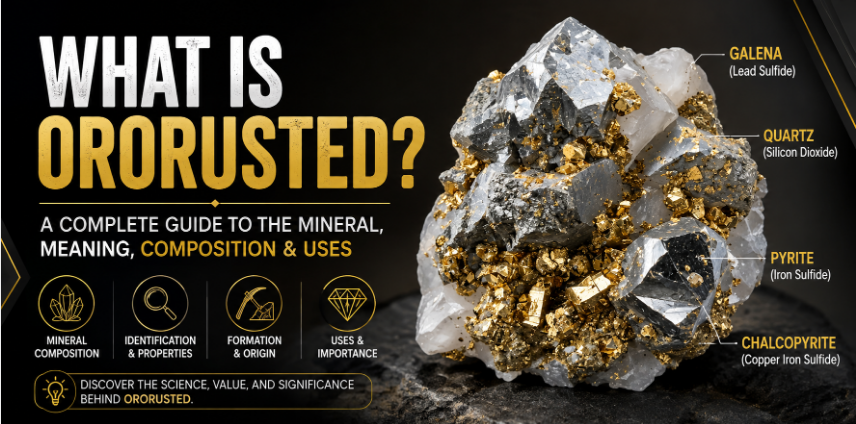
If you have come across the term Ororusted alongside an image of a striking metallic mineral specimen, the visual context provides an important clue. The specimen shown here features a combination of silvery-gray metallic crystals, golden brassy mineralization, and pale translucent crystals. Mineral specimens with this kind of appearance commonly contain minerals such as galena, chalcopyrite, pyrite, and quartz.
The word Ororusted, however, is not a standard mineral name recognized in mainstream mineralogical terminology. That means it shouldn’t be presented as though it were the official name of a single mineral species. Instead, the term is best treated as a keyword or descriptive label associated with a mineral specimen or a particular visual representation.
Understanding the minerals in the specimen is much more useful than assigning an unsupported chemical definition to the word. Galena, for example, is a lead sulfide mineral known for its metallic gray appearance and commonly cubic crystals, while chalcopyrite is a brass-yellow copper-iron sulfide. Quartz provides the transparent to white crystalline material often seen surrounding metallic sulfides.
This guide explains what the image shows, which minerals may be present, how these minerals differ from native gold, why the specimen has such a distinctive appearance, and what collectors should know when identifying a piece like this.
What Is Ororusted?
Ororusted is not an officially established mineral species name in standard mineralogical classification. The term appears to be used as a keyword associated with a mineral specimen rather than the formal name of a mineral with a defined chemical formula.
That distinction is important because mineral names normally refer to specific naturally occurring substances with identifiable chemical compositions and crystal structures.
For example, galena has the chemical formula PbS, while chalcopyrite has the formula CuFeS₂. Quartz is SiO₂. These are established mineral species with documented physical and chemical properties.
The specimen in the supplied image appears to show several mineral phases rather than one material. The golden areas have the appearance commonly associated with brassy sulfide minerals such as chalcopyrite or pyrite, while the silver-gray portions resemble galena. The lighter translucent material is consistent with quartz or another light-colored mineral.
Because a photograph alone cannot provide a definitive mineral identification, the exact composition should not be treated as confirmed without proper testing.
What Does the Ororusted Image Show?
The image is particularly interesting because it contains several contrasting textures and colors.
The most noticeable features are the silver-gray metallic crystals and the golden-yellow metallic areas. Around them are pale, translucent crystals that form part of the mineral matrix.
This type of combination is common in complex sulfide mineral specimens. Mineral collections frequently contain specimens where galena, chalcopyrite, pyrite, sphalerite, and quartz occur together. Museum and mineral-collection records document similar associations.
The image should therefore be viewed as a specimen displaying multiple minerals rather than assuming that every metallic-looking portion is gold.
That is one of the most important points when looking at photographs of rocks and minerals.
The Silver-Gray Material
The large silver-gray crystals are visually consistent with galena, especially where the crystals have blocky or cubic forms.
Galena is a lead sulfide mineral with the chemical formula PbS. It commonly has a metallic gray appearance and can form distinctive cubic or octahedral crystals.
Its bright metallic luster can make it look almost like polished metal when photographed under strong lighting.
Galena is also notably dense, which means specimens containing substantial amounts of it can feel surprisingly heavy for their size.
The Golden Material
The golden or brass-colored material is another important feature.
A golden appearance does not automatically mean native gold.
Minerals such as pyrite and chalcopyrite can have strong metallic yellow or brassy colors. Chalcopyrite is particularly well known for its brass-yellow appearance and is an important copper ore.
Pyrite can also produce a bright metallic appearance and is commonly associated with quartz and other sulfide minerals.
This is why photographs alone can sometimes make a mineral specimen look as though it contains large amounts of gold when the visible yellow material is actually sulfide minerals.
Is Ororusted Real Gold?
There is not enough evidence from the image alone to say that the golden areas are native gold.
In fact, the appearance of the specimen is compatible with several common metallic sulfide minerals.
Chalcopyrite has a brassy yellow color and is one of the most common minerals that can be mistaken for gold.
Pyrite is another possibility. Its familiar nickname, “fool’s gold,” comes from its visual similarity to gold.
Native gold has different physical properties from pyrite and chalcopyrite. Gold is malleable, whereas pyrite and chalcopyrite are brittle. A mineralogist or experienced collector can use physical tests, microscopy, specific gravity, hardness, streak, and other characteristics to distinguish them.
For an unknown specimen, professional identification is preferable to relying on color alone.
What Is Galena?
Galena is one of the most visually distinctive minerals that may be present in a specimen like this.
Its chemical formula is PbS, meaning it consists primarily of lead and sulfur. It is the most important ore mineral of lead and has been known and used for thousands of years.
One of its defining characteristics is its metallic gray color.
Galena also commonly forms cubic crystals. These crystals can have highly reflective faces that create the dramatic silver appearance visible in many mineral photographs.
When galena occurs alongside golden chalcopyrite and clear or white quartz, the contrast can be especially striking.
Galena Crystal Shape
Crystal shape is one of the useful clues mineral collectors use during identification.
Galena commonly develops cubic forms because of its crystal structure. Some specimens also display modified or twinned forms.
In mineral collections, sharp galena cubes are highly attractive because their geometric faces contrast with irregular masses of sulfides and crystalline quartz.
The image supplied here shows several areas with a blocky metallic appearance, which helps explain why galena is a reasonable mineral to consider when interpreting the specimen.
What Is Chalcopyrite?
Chalcopyrite is a copper-iron sulfide mineral with the chemical formula CuFeS₂.
It is typically brass-yellow when freshly exposed and has a metallic luster. It is also an important source of copper.
One reason chalcopyrite is relevant to the What Is Ororusted image is its strong golden appearance. In photographs, it can look remarkably similar to gold, particularly when the lighting is bright.
However, its physical properties and chemistry are very different from those of native gold.
Chalcopyrite can also develop colorful tarnish under certain conditions. Weathered or treated specimens may show blue, purple, green, or other surface colors, although the untreated mineral is generally recognized for its brassy yellow appearance.
What Is Pyrite?
Pyrite is an iron sulfide mineral with the chemical formula FeS₂.
It is famous for its metallic luster and yellowish-brass color, which can resemble gold.
That resemblance has made pyrite one of the best-known minerals among beginners and collectors.
Pyrite frequently forms cubic crystals, although it can occur in several other crystal habits. Its appearance can range from relatively smooth metallic faces to granular or crystalline masses.
When pyrite occurs with quartz, galena, and chalcopyrite, the resulting specimen can contain several metallic colors and crystal textures.
This makes identification more challenging but also makes the specimen visually interesting.
What Is Quartz Doing in the Specimen?
The pale translucent material visible around metallic minerals is likely to represent quartz or another light-colored mineral, although a photograph isn’t enough to establish the exact identification.
Quartz is silicon dioxide, with the chemical formula SiO₂.
It is one of the most abundant and widely recognized minerals on Earth.
In hydrothermal mineral deposits, quartz can occur together with sulfide minerals. Mineral collections therefore frequently show quartz surrounding or supporting minerals such as galena, pyrite, and chalcopyrite. Examples of such associations are documented in mineral collections and specimen catalogs.
The translucent appearance of quartz can provide a strong visual contrast against dark metallic sulfides.
Why Do These Minerals Occur Together?
The association between quartz and sulfide minerals is not accidental.
Many metallic mineral deposits form through hydrothermal processes, where hot fluids move through fractures and spaces in rocks.
As temperature, pressure, chemical composition, and other conditions change, dissolved elements can precipitate from these fluids and form minerals.
Quartz can crystallize alongside metallic sulfides under suitable geological conditions.
This helps explain why a single specimen may contain several different minerals.
Instead of thinking of the rock as one uniform material, it is more accurate to think of it as a small record of geological processes.
How to Tell Gold From Pyrite and Chalcopyrite
The visual difference between gold and gold-colored sulfide minerals can be subtle in photographs.
There are, however, several physical differences.
Gold is highly malleable. If subjected to appropriate testing, a piece of native gold tends to deform rather than simply fracture.
Pyrite and chalcopyrite are brittle minerals. Their crystals can break or crumble rather than flatten like gold.
Color is also not enough.
Natural gold can vary in color depending on its composition and surrounding material. Pyrite and chalcopyrite can also appear different depending on surface condition, lighting, weathering, and crystal form.
For valuable specimens, laboratory analysis is the safest way to establish composition.
Why Does the Specimen Look Metallic?
Mineral luster describes how a mineral’s surface reflects light.
Galena, pyrite, and chalcopyrite all commonly exhibit metallic luster.
This is why they can appear almost like pieces of metal in photographs.
The effect becomes even stronger when the crystals have clean, flat faces.
A large galena crystal can reflect studio lighting very strongly, producing bright silver highlights. Chalcopyrite can create warm golden reflections, while quartz scatters light differently because of its glassy luster.
The combination creates the dramatic appearance visible in the What Is Ororusted image.
Is Ororusted a Mineral Name?
Based on established mineralogical terminology, What Is Ororusted should not be treated as the formal mineral name of the specimen.
Formal mineral identification normally requires more than a visual label.
Mineralogists may consider:
- Chemical composition
- Crystal structure
- Crystal habit
- Hardness
- Cleavage
- Streak
- Luster
- Specific gravity
- Optical properties
- X-ray diffraction
- Other analytical techniques
A photograph can provide useful clues, but it cannot replace mineral identification.
This is especially important when several minerals occur in the same specimen.
How Mineral Collectors Identify a Specimen
Experienced collectors generally begin with visual observation.
They examine the color, luster, crystal shape, transparency, cleavage, and association with other minerals.
The specimen’s location can also be extremely useful.
A mineral that occurs in one geological environment may be much more likely than another mineral with a similar appearance.
For example, if a specimen is known to come from a mining district famous for galena, sphalerite, chalcopyrite, pyrite, and quartz, those minerals become reasonable candidates.
Mineral databases and museum collections can then help compare the specimen with documented examples.
For a definitive result, laboratory testing may be required.
What Makes This Type of Specimen Interesting?
The appeal of specimens like the one shown in the image comes from their combination of color, geometry, texture, and mineral association.
The silver-gray metallic crystals create sharp geometric forms.
The golden sulfides provide a strong visual contrast.
The translucent quartz softens the appearance and adds depth.
Together, these characteristics create a specimen that can be attractive even to someone who has little previous knowledge of geology.
For collectors, however, visual appeal is only one consideration.
Crystal quality, locality, rarity, condition, size, provenance, and the quality of the mineral association can all influence the importance of a specimen.
Common Minerals That Can Look Like Gold
Several minerals can be mistaken for gold.
Pyrite
Pyrite has a brassy yellow color and metallic luster. Well-formed cubic pyrite crystals are particularly recognizable.
Chalcopyrite
Chalcopyrite is also brassy yellow and can appear strongly golden when freshly exposed.
Mica
Certain types of mica can reflect light with yellow or golden flashes, although their physical appearance is usually different from metallic sulfides.
Weathered Sulfides
Weathering can change the surface appearance of sulfide minerals and sometimes create confusing colors.
Because of these possibilities, identifying gold from a photograph is unreliable.
Is Galena Valuable?
Galena itself is generally valued differently from precious metals.
Its importance comes primarily from its role as the principal ore of lead and from its geological and What Is Ororusted mineralogical characteristics.
Individual mineral specimens can have collector value depending on crystal quality, locality, size, aesthetics, rarity, and condition.
A specimen containing attractive galena crystals combined with chalcopyrite, pyrite, and quartz may be more desirable to collectors than an ordinary piece of massive galena.
However, the presence of shiny crystals does not automatically establish a high monetary value.
Can You Keep a Galena Specimen at Home?
Galena contains lead, so reasonable handling precautions are appropriate.
A mineral specimen sitting undisturbed on a shelf isn’t the same as ingesting or inhaling mineral dust. However, collectors should avoid creating dust by cutting, grinding, or aggressively breaking galena-containing material without suitable controls.
Washing hands after handling is a sensible precaution, particularly before eating.
Mineral dealers also commonly recommend avoiding unnecessary contact with dust or residues from lead-bearing minerals.
The same general principle applies to mineral collecting: admire the specimen, but handle it responsibly.
Can Ororusted Be Used to Describe This Type of Mineral?
If Ororusted is being used as a descriptive or website-specific keyword for the pictured specimen, it can be discussed in connection with the image.
However, it should not be presented as though mineralogists officially classify galena, chalcopyrite, pyrite, or quartz under the name Ororusted.
A more accurate description would focus on the actual minerals and their visible characteristics.
For example, the specimen can be described as a metallic sulfide mineral assemblage featuring silver-gray galena, golden chalcopyrite or pyrite, and light-colored quartz when those identifications are supported.
That wording provides readers with useful geological information without inventing a mineral classification.
What Should You Look for in an Ororusted Mineral Specimen?
If you’re using the term Ororusted to search for or discuss this type of specimen, several characteristics are worth examining.
Crystal Form
Look closely at the shapes of individual crystals.
Cubic forms may point toward galena or pyrite, although crystal habit alone is not always enough for identification.
Metallic Luster
Silver-gray and golden areas with strong reflections may indicate metallic sulfides.
Color
Golden yellow can suggest chalcopyrite or pyrite, while gray metallic areas may suggest galena.
Color should always be treated as a clue rather than proof.
Matrix
The surrounding material can provide important geological context.
Quartz is a common matrix mineral in many hydrothermal sulfide specimens.
Crystal Associations
The minerals surrounding a crystal can sometimes help identify it.
Galena, chalcopyrite, pyrite, sphalerite, and quartz are known to occur together in mineral specimens from several mining environments.
Why the Word Ororusted May Be Confusing
The biggest issue with the term is that it sounds like it could be a formal mineral name.
It isn’t enough for a word to look scientific.
Mineralogy uses a formal naming system. Mineral species are defined through chemical and structural characteristics and recognized through established scientific processes.
A term can still be useful as a keyword, label, product name, or descriptive expression without being a mineral species.
That distinction prevents a lot of misinformation.
Ororusted vs. Gold-Bearing Mineral Specimens
It’s also useful to distinguish between a mineral specimen that looks golden and one that actually contains native gold.
A golden appearance can come from chalcopyrite or pyrite.
A specimen may also contain microscopic gold that isn’t visible to the naked eye.
Conversely, a beautiful golden crystal may contain no gold at all.
Determining whether gold is actually present requires appropriate mineralogical or analytical testing.
This is particularly important when a specimen is being sold as a gold-bearing rock.
How Geologists Study Mineral Associations
Geologists don’t rely only on photographs.
They may study mineral relationships, textures, chemical compositions, alteration patterns, and the geological setting in which the minerals occur.
Microscopic examination can reveal relationships that are impossible to see from a normal photograph.
Laboratory techniques can then establish the elements present and the minerals’ crystal structures.
This matters because minerals that look similar can have very different compositions.
A visually impressive specimen is therefore only the starting point of mineral identification.
What the Image Can and Cannot Tell Us
The supplied image gives several useful visual clues.
It clearly shows:
- Silver-gray metallic material
- Golden-brassy mineralization
- Pale translucent crystalline material
- Multiple crystal textures
- Strong metallic reflections
- A complex mineral association
But it cannot reliably establish:
- The exact chemical composition
- Whether native gold is present
- The exact locality
- The age of the specimen
- The precise mineral proportions
- The monetary value
- The official identity of the term Ororusted
Those details require additional evidence.
That distinction is important if the specimen is being used for educational, collecting, or commercial purposes.
Frequently Asked Questions
What is Ororusted?
Ororusted is not a recognized standard mineral species name. In the context of the supplied image, the term can be used as a keyword for a mineral specimen featuring metallic gray and golden mineralization, but the actual minerals should be identified separately.
Is Ororusted a type of gold?
There is no established mineralogical evidence that Ororusted is a type of gold. The golden appearance in the pictured specimen could be produced by minerals such as chalcopyrite or pyrite rather than native gold.
What minerals are visible in the Ororusted image?
The specimen appears consistent with an association of metallic sulfides and a light-colored crystalline matrix. Galena, chalcopyrite, pyrite, and quartz are reasonable mineral candidates based on the appearance, although a photograph alone cannot provide definitive identification.
What is the silver mineral in the specimen?
The silver-gray metallic crystals may be galena. Galena commonly has a metallic gray appearance and forms cubic or blocky crystals.
What is the golden mineral in the specimen?
The golden material may be chalcopyrite or pyrite. Both minerals can have a brassy yellow metallic appearance. The exact identification requires physical or laboratory testing.
Is chalcopyrite the same as gold?
No. Chalcopyrite is a copper-iron sulfide with the chemical formula CuFeS₂, while gold is a chemical element with the symbol Au. Chalcopyrite can look golden but has very different chemical and physical properties.
Is galena dangerous?
Galena contains lead, so it should be handled responsibly. Avoid generating or inhaling dust, and wash your hands after handling specimens.
Is Ororusted an official geological term?
Ororusted should not be treated as an official mineralogical species name without authoritative evidence establishing that classification.
Can a photograph identify a mineral?
A photograph can provide useful clues, particularly regarding color, luster, and crystal form, but it usually cannot confirm a mineral’s identity. Physical tests, locality information, and laboratory analysis may be necessary.
Why does this specimen look like it contains gold?
The combination of bright metallic yellow minerals and silver-gray crystals creates a strong gold-like appearance. Chalcopyrite and pyrite are common reasons mineral specimens can look golden without containing visible native gold.
Conclusion
The Ororusted keyword is best understood through the mineral specimen shown rather than through an invented dictionary definition.
The image displays a striking combination of silver-gray metallic crystals, golden-brassy mineralization, and light crystalline material. Based on appearance, minerals such as galena, chalcopyrite, pyrite, and quartz are relevant when describing this type of specimen. Similar combinations are well documented in mineral collections and geological records.
The most important point is that golden color does not automatically mean gold. Chalcopyrite and pyrite can both produce strong metallic yellow tones, while galena is known for its distinctive gray metallic appearance.
Because Ororusted isn’t an established mineral species name, it shouldn’t be given a made-up chemical formula or presented as a scientifically recognized mineral. Instead, the term can be naturally incorporated as the search keyword while the article provides accurate information about the mineral characteristics shown in the image.
For anyone interested in this kind of specimen, the best approach is to look beyond its appearance. Crystal form, mineral associations, locality, physical properties, and proper testing all provide much stronger evidence than color alone.